Thursday, April 10, 2008

MELBOURNE TO ADELAIDE


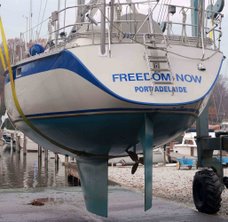
Freedom Now arrived safely in Melbourne on January 22 and we were able to visit her (under escort) on the dock. We accompanied the Australian Quarantine Service officer on his inspection and were told in rigid tones "The boat can't be moved from the dock until it has been fumigated". It was another 4 weeks before we saw her again. Our agent arranged for a company to carry out the fumigation. They erected a tent over her but before the fumigation could be completed the tent was shredded in a storm. The fumigation company could not complete the work for another week. They probably had to get a new tent made. Then the trucking company claimed they couldn't move it without a wide load permit and the bureaucratic wheels that issue such permits could take another week to turn.
Feb 18, the boat arrived by truck at the Sandringham Yacht Club and we were able to start work putting her back together. We worked from sunrise to sunset and finally got her in the water and the mast stepped on Feb 29. The facilities at the club were excellent and the staff very helpful.
We still had a lot of work to do and we were not ready to sail away until March 12. The frustrating delays enabled us to take advantage of some of Melbourne's cultural events and we enjoyed catching up with some long term friends, the Coulsons from Alice Springs days and the Rose family, involved in Churches of Christ Ministry.

Our sail from Melbourne to Adelaide was one of our best. We left Sandringham early in the morning to arrive at "the rip" at slack water. Port Philip Bay is a huge volume of water with a narrow opening to Bass Strait. This means the outflow and inflow never ever get synchronised with the tides. The resulting disturbed water at the heads known as "The Rip" can result in ugly conditions. We made good time and arrived about 30 minutes before slack water. We decided to take advantage of the 3knot outflow current but were amazed at the disturbed water we experienced so close to the time of slack water. We sailed through the night around Cape Otway arriving at picturesque Port Fairy the next day. Staying in Port Fairy is always a delight. We tied up to the dock in front of Gary the boat builders house in the Moyne River with a constant stream of visitors walking along the dock between the fishing boats, yachts and houses. It is the closest thing to a small English fishing village we have experienced. Many of the dock wanderers stop for a chat and just a few minutes walk from the boat are some of the finest cafes, restaurants and bakeries we have experienced. It was hard to leave but the weather was changing and we needed to get home. Our course was mainly NW and a series of cold fronts sandwiched between high pressure centres meant the forecasts were for winds to be NW at 30 knots ahead of the fronts. Beating into 30knots is not high on our list of delights. One front passed late on Monday afternoon and the next was due on Thursday afternoon. We left at 2300h Monday evening, carefully winding our way out of the Moyne River. Conditions were good with a swell of about 3 metres and winds SW up to 25knots so that once we had passed Portland we were able to free sheets and romp along.

Winds moderated and backed further East the further we went. By Wednesday evening we were in Backstairs Passage and once in the lee of Kangaroo Island and out of the swell the seas flattened out nicely. We rounded Cape Jervis and started heading up the home stretch of Gulf St Vincent just before dark. The winds were light and our boat speed sometimes dropped to 3 knots but we could see no point in hurrying so we took it in turns having a restful sleep and watching with nostalgia as the lights of our home city floated by in the distance. We tied up at the Royal South Australian Yacht Squadron at 0530 Thursday 20, March (Maundy Thursday) and slept for a few hours before travelling by train to our home at Blackwood. Freedom Now seemed quite happy in her new home and we were content to be close to family again. The memories of the places we have been and the many friends we have met will be treasured and recalled for as long as we live. What wonderful things we have been able to achieve. What wonderful experiences we have been able to share. It is a wonderful world! Farewell for now faithful readers.


Thursday, February 7, 2008

ANNAPOLIS

A sail up the Delaware Bay,motor through the Chesapeake and Delaware Canal and sail down the Chesapeake Bay to Annapolis was all that we needed to complete our magic cruise of the North Atlantic.
Except for the shipping channels the Delaware is muddy, shallow and uninviting. The run up the bay is easy if the conditions are right but if the wind is against the tide it can be hell, as George Washington discovered in his crossing many years ago, now immortalised in a painting hanging in the National Museum of Art.
To get it right we left Cape May at 0430h and sailed to the entrance of the Delaware. The short cut through the Cape May Canal was not an option for us as the bridge clearances were not adequate for our mast height. We scraped the muddy bottom leaving the marina but once out had no problems navigating our way in the dark.
The run up the Delaware was a dream with the tide and wind running with us all the way. We passed a prominent nuclear power plant and arrived at the entrance to the C&D canal at 1500h (a distance of 80 nautical miles). Motoring through the canal was easy and we were able to anchor in the boat basin at Chesapeake City by 1700h. Without an anchor windlass we took care to get the anchor set right first time. We were anchored in a perfect position. Hurricane Noel was moving up the coast from Florida and forecast to bring strong winds to the whole area for the next few days but
we were well protected and far enough inland to worry too much about it. We listened on our SSB radio to messages of panic from a catamaran heading to Bermuda and caught in the hurricane's full force. The owner pleaded in a trembling voice for our friends on Ketchup 11 to phone his wife and tell her he loved her. He obviously doubted if he would see his wife again. "This is the worst night of my life", he said. We spoke to him ourselves and told him we had survived a similar storm when sailing to New Zealand and that he would survive this one too. "Just keep eating and get as much rest as you can", Bruce encouraged. They did survive and arrived in Bermuda with a lengthy repair list.
Our short 3 day stay in historic Chesapeake City with its well maintained old buildings was made even more delightful by Buddy the Dockmaster who went out of his way to help visiting yachties by driving them to the supermarket or anything else they needed. We were told we had to meet Nick, the local New Zealander who had an accent like ours. Nick was a delightful character who had married a local girl and like many New Zealanders knew a lot about boats. His advice was invaluable.

We needed advice at that stage as we had started to feel very homesick and the thought of being away from our family and friends for another two or three years had become a blot on our enthusiasm. We were finding the long passages and the loss of sleep on overnight sailing was getting more difficult and we had not been successful in finding someone willing to crew for us on our next big leg to the Caribbean. We made a bold but very difficult decision. We would ship the boat back to Australia and take the family on short sailing trips in our dotage. Had we realised the difficulties that would entail we might have decided otherwise.

On Sunday November 4, we retrieved our anchor by hand at 0430h and sailed under near perfect conditions to Annapolis, arriving at Clements Creek community marina at 1500h. Our very good friends the Melchners had arranged a marina berth there for us to use and it was great to be greeted as we berthed by John who took our lines. Annapolis was like a second home. The help and support we received from our yachting friends there will never be forgotten. We were feted, dined, taken for medical treatment and housed in wonderful style. Thanks John, Carol, Hank, Fran, Sandy, Lyn, Bob, Matthew and Sheila for all you did for us.

We had mixed feelings. We had just completed a near perfect cruise of the north Atlantic following John Melchner's excellent recommendations but we were abandoning our dream of sailing through the Panama and across the Pacific Ocean to Australia. The thought of being reunited with our grandchildren earlier than originally planned weighed heavily in the balance as we tried to integrate our thoughts and feelings.

Autumn was well advanced and we still had much to do.

Wednesday, February 6, 2008

NEWPORT, BLOCK ISLAND, CAPE MAY

We had just 24 hours before bad weather with strong southerlies stopped us sailing south so we departed Cuttyhunk for Block Island. The winds were 15-20 knots but easing. Block Island was an easy day sail away and we dropped anchor in the Great Salt Pond, New Harbor at 1500h. We had originally intended to sail down Long Island Sound and visit New York City but decided instead to catch the first weather window to sail direct from Block Island to Cape May. The weather was against us for the next couple of days and when we were offered a free mooring we decided to leave the boat at the strategic take off point at Block Island and take the ferry across to the mainland to visit Newport the home of the America's Cup for many years and to visit the Herreshoff Museum at Bristol RI. To lovers of great sailing boats the name Herreshoff is uttered in hushed tones of awe and respect. The museum houses a number of boats designed and built by the Herreshoffs and many of their plans and design tools. It is still a source of amazement that Nat Herreshoff could design America's cup winning boats by whittling a half hull shape in a block of wood until it looked and felt right and have the boat trounce a Thomas Lipton funded boat designed and tested by the most scientific methods then available.
The America's Cup Hall of Fame was a bonus.
Newport is a great place for sailors and Australian yachties are held in high regard and fondly remembered after the many America's Cup challenges and finally victory!! One of its special places is the Seamen's Church Institute housed in an old building near the waterfront. It provides every service a visiting yachtie could ask for: A cafe serving good cheap food, showers, laundry, computer and wi-fi access, library, mail collection and a chapel.
We also visited the International School of Wooden Boat Restoration and observed first hand the wonderful skills their students are able to develop. Bruce wanted to enroll. A night of luxury in a motel and bus rides through Providence to Point Judith and Ferry to Block Island completed our side trip. The weather forecasts for the next few days were not good and we began to question our decision to bypass New York. Block Islanders were good to us though and we attended the Baptist Church on Sunday and were invited to the home of a local family who had sailed to Australia and flown home for a while.
It was not until the following Wednesday October 24, that the weather looked right to sail south. The forecast was for winds W to NE to a maximum of 20 knots. The forecasters got it wrong. We estimated the trip to Cape May (203 nautical miles) would take us about 35 hours so braced ourselves for two days and one night at sea. By nightfall the winds were up to 30 knots and by Thursday morning we had gusts to 35 knots and breaking seas. It was fast but not comfortable sailing. It was rough enough for us to radio the Cape May Coast Guard to enquire about the conditions at the breakwater entrance. We decided to enter and had a rough entry with large breaking waves on our beam until we were well inside the breakwater. Trying to anchor in 35 knots is not easy and we got it wrong. We were too close to the main chanel and in the process we seized our anchor windlass so we couldn't use it to reset our anchor. We stayed the night and the next day when the wind had eased a little we were able to use a line and chain hook to inch the anchor chain up by using the main sheet winch. Rather than anchor again we decided to go into the Canyon Club Resort Marina but nearly fainted when they told us their charges were $125 a night.
We needed to get our windlass out of the boat and send it to an expert in Florida for repairs so we really had no choice. On Saturday morning, with the work completed and the weather, miserably cold, wet and windy, we took a taxi into the main shopping area of Cape May for a southern style breakfast of coffee, eggs, bacon and grits. The cafe proprietor was extremely helpful and suggested we might be interested in the bird show that was being held in the Convention Hall.

We went and discovered the hall full of bird watchers, binoculars, scopes, book sellers and a display of live raptors mostly birds that had been injured and nursed back to health by the owner of a bird sanctuary a nationally renowned ornithologist. Tethered and standing on their individual perches were magnificent looking eagles, falcons, hawks, and owls. The owner of the sanctuary was present and had scheduled a series of lectures. We made sure we were well positioned for the first of these. We could never have guessed at the saga that was about to unfold as one by one the birds were taken from their perches clipped to the lecturers gauntlet and paraded around for the audience to see at close quarters. A small falcon was let go to fly around the hall and quickly returned to the gauntlet bribed by a morsel of meat. "These birds of prey always attack the necks of their prey, so watch your necks" the lecturer cajoled. Towards the end of the lecture he asked how many would like to see an Arctic Falcon in free flight outdoors. Outside it was raining and blowing a gale but the majority wanted to see it. So outside we went. The falcon was released, soared into the sky and then plummeted into the centre of a flock of pigeons grabbing a pigeon in its talons and neatly cutting its jugular with its beak. It then flew out of sight with its kill. The lecturer and his assistants set off to track it down using a radio direction finder. Bruce decided to go back into the hall out of the rain but Bonnie tagged along with the lecturer and a couple of others to see where it had gone. When they finally tracked the falcon down they discovered it had flown into the main shopping mall dragged its prey into a shoe store and started to dismember it's pigeon lunch. Women were running out of the store screaming and the police had been called. The police arrived, the lecturer recovered the falcon clipping its tether to his gauntlet and removed the dead pigeon. The police refused to let him leave the store and return to the hall as they seemed to think that with a dead pigeon and screaming women some horrendous crime must have been committed. In spite of his request to return to finish his lecture, he was detained in the store until the animal control officer could be summoned. Cruelty to animals was one possible charge suggested. Half an hour later a rather frazzled lecturer with Bonnie, falcon and dead pigeon in tow returned to the hall but he was in no mood to continue his lecture and outdoor flights were ruled out for the rest of the day. It was rumoured that the police officers involved spent the rest of the day searching the statute books determined to find some charge to justify their efforts. Only in America?

We wandered back through the town cold and wet and on the way spied a billboard in front of the Cape May Baptist Church that said "Thanksgiving Celebration today. Public welcome." Any excuse to get out of the cold, so we entered. For the next couple of hours we enjoyed a good old fashioned social event with home made chilli con carne, corn bread, hot dogs, hot cider and some fun activites, bobbing for apples, eating buns on string, potato peeling contest (won by Bonnie) and a cake walk. What is a cake walk? When the music stops you stand on the nearest number and if it is drawn you win a cake. Bruce won a huge cake covered with chocolate icing that fed us for the next three days. By the end of the social we had made some good friends and arrangements had been made for a ride back to the boat, and a ride to church next morning. We also dined with our new found friends on Sunday evening before planning to move on.

CAPE COD CANAL

The Cape Cod Canal provides a wonderful short cut provided you get the tide right. The northern entrance was only 50 miles from Salem and the weather was perfect. Under full main and headsail we sailed on a broad reach at 7knots arriving at the entrance with the tide flowing with us at about 4 knots. We had planned to spend the night at the marina but after refuelling we decided we had just enough daylight to transit the canal. Motoring at 6 knots through the water we travelled at 10 knots over the ground. In less than an hour we had done our transit of the canal and picked up a mooring at Onset for the night.
The next day with westerly winds of 10-15 knots and clear skies we had an easy sail down Buzzards Bay to Cuttyhunk Island, negotiated the narrow entrance and picked up a mooring in the dredged pond. The moorings were very close together and had a stiff penant and mooring ring sticking up about 6 feet out of the water. Threading a line through the ring was tricky and even though we pulled ourselves up on a short tether we still fouled the mooring behind when we swung on the breeze. As it was the end of the season there were few boats in the harbor and we were disappointed when a young man appeared alongside in a dinghy and asked us for $40 (the nightly mooring fee). He assured us it was the last day the charge would apply and we could stay from then on for nothing. It was tempting but we needed to press on. Cuttyhunk is a delightful little island full of holiday homes, shacks and a small permanent population of mainland dropouts. Electric golf carts provide the main form of transport and when we expressed a desire to do some coastal walking an elderly female resident invited us to jump on board her golf buggy and drove us down the narrow roads and tracks to a convenient sarting point.
It was now mid October and the nights were getting cold. We pulled out our down filled sleeping bags and decided to keep moving south with the ever increasing flocks of Canada geese.

Monday, February 4, 2008

SALEM AND BOSTON


About the only things we knew about Salem before we sailed in were it's sad history of witch trials immortalised in Arthur Miller's play, "The Crucible" and its importance as a shipping centre in early American trade. It is a delightful spot which has escaped the total detruction of early houses and mass redevelopments of many cities. We arrived just before Halloween and the witches were out in full force. We walked past many little stores offering Tarot readings, seances and fortune telling but manged to escape unscathed and unread. We toured a few historic houses, and visited a couple of museums but the event which remains indellibly etched in our minds was a dramatic recreation of the arrest and preliminary hearing of Bridget Bishop in 1692. We saw her arrested in the street and dragged screaming into the old town hall where we the audience were presented the testimonies of witchcraft that were actually levelled against her and invited to decide whether she should be committed for trial. Apart from a character that rivalled Shakeseare's Shrew we were unimpressed with the evidence presented against her. It lacked logic, reeked of superstitious inuendo and would hopefully be laughed at in any modern court. At the end of the testimonies the audience was asked by show of hands to indicate whether she should be committed to trial. A very slender majority decided she should not be sent to trial. The audience sat in silence as the actress playing the role of Bridget stepped forward and thanked us for not sending her to trial and then proceeded to explain that in 1692 the decision was different, she was tried, found guilty and was the first of 19 people hung for witchcraft in Salem. How far have we really progressed? Witch hunts are still with us! There are still many who want to declare others guilty until they are proven innocent. Enough preaching!

The weather continued in a foul mood so with our boat safely on a mooring we travelled by train into Boston. Bruce kept walking around reciting,

"Here's to good old Boston,
The home of the bean and the Cod,
Where the Cabots speak only to the Cabots
And the Lodges speak only to God."

We experienced no such implied snobbery and saw no sign of the Cabot and Lodge families. We were fortunate to have as a walking tour guide a professor of American History who did his best to remove the facts of the American Revolution from the myths and mysty eyed idealism that so often surround them in American popular beliefs. He drew a very interesting parallel between the American Revolution and Vietnam and suggested we still need to learn the lessons of our history.

We only had one day in Boston and spent the afternoon on the water with a tour of the harbour and the oldest ship still on the active list of the American Fleet. "The Constituion" was built in 1750s and is lovingly maintained as a working museum of that era, a truly magnificent vessel

Sunday, February 3, 2008

MOUNT DESERT ISLAND, MAINE

The Acadia National Park on Mount Desert Island is a jewel in the crown of America's National Parks. After departing Bar Harbor for a mooring at North East Harbor, we spent four glorious days walking around the Park. Free buses leave the harbor every 30 minutes from early morning until dusk.
The park has an extensive network of cycling and walking trails. 45 miles of rustic carriage roads lace the park. John D Rockefeller Jr. wanted to travel on motor-free byways by horse and carriage into the heart of the island and these carriage roads constructed with stone bridges and compacted broken stone surface between 1913 and 1940 were his gift to the park and its visitors. The irony of course is the fact that his ability to fund these carriageways free from motor vehicles came from wealth derived from the Standard Oil Company established by his father.
As we walked along these magnificent carriageways we were grateful for his bequest and kept imagining how beautiful they would be for cross country skiing after a heavy snowfall.
It was now the first week in October, the days were shortening, the weather chilly overnight and we learned that after Columbus Day (Monday October 8) the bus service would end and the park would virtually close down. We needed to sail south as soon as possible but this was a treasure we could not leave just yet.
We had to climb a mountain first. With two days to "shut down" we set off on a memorable walk and climb. We started with an easy stride along the carriageway skirting Bubble Pond surrounded by the brilliant gold and reds of autumn leaves and climbed a steep rocky track to the top of Pemetic Mountain (1,234 feet). The fogs had gone and the clear views of rugged coasts, mountains and lakes were stunning. We lunched at the top and reluctantly descended the other side of the mountain and caught the free bus back to our boat.
Sunday morning was bleak and overcast so as is our custom we set off for the nearest church. We had noticed a sign at the local library that the Society of Friends meeting was held there every Sunday so off we went for our first experience of Quaker worship. We arrived a few minutes late and were ushered into a room where a group of about 20 people were sitting in a circle in total silence. We took our seats in the circle and sat in silence for an hour. Afterwards we were assured that the meetings are not always like that. Sometimes several people speak as they receive enlightenment. We concluded that while an hour of silent prayer was quite OK and a pleasant change from clanging guitars and thumping drums, it is not something we seek as a regular worship diet. Perhaps just a little music and liturgy next time.

On Columbus day we sailed south to Deer Island where we had been invited to pick up a guest mooring owned by Phil and Linda, local Maine residents we first met in Baddeck. We had ordered a new refrigeration unit and had it delivered to their home. It was an easy day sail with a bit of tricky navigation through narrow but well marked channels winding between convoluted islands. We still had to wind our way through a minefield of lobster traps but the day was clear and sunny so it wasn't anywhere near as much fun as in the dense fog. Phil delivered our refrigeration unit to our boat and we spent a day installing it and visiting them in their magnificent two story home just ashore from the mooring. Their help was invaluable and with their assistance we were able to get our empy gas bottle filled just in time to leave on Wednesday October 10. The weather forcast for the next 24 hours was good with gentle to moderate NE winds but deteriorating after that. We felt we needed to move south quickly so sailed overnight to Salem, Massachusetts. We arrived just before the foul weather hit.


BAY OF FUNDY

The Bay of Fundy has the biggest tides in the world with one tidal station recording rises and falls of over 16metres. This means strong currents for the whole of the bay and around the southern foot of Nova Scotia. Timing is everything. To get it right we left Shelburne at 0430 and had a wonderful sail around the bottom of Nova Scotia and then set course for Bar Harbor, Maine. The weather forecast was good with light winds and patches of fog. Because of the strong tidal currents we simply set a compass course and ignored our cross track error and rumb line. The plot of our course was fascinating as it is the first time our track formed a perfect sine curve as we went up with the flood and down with the ebb. We motored for a while but were making such good time we estimated we would arrive in Bar Harbor berfore dawn the next day so we killed the motor and were content to sail at 3 knots with very little breeze.

By early morning we started the motor again and motored the rest of the way. By 0600h we were in dense fog which thickened further as we approached the coast of Maine. The forecast patches of fog became a dense blanket covering a large area. The visibility was reduced to little more than the length of our boat. Then the nightmare really began when we encountered a mine field of lobster traps with lines and floats just waiting to wrap themselves tight around the propellors of unsuspecting yachts. Bonnie was on the helm and the visibility was so bad she could not see the trap floats in time to alter course to miss them. Bruce stood in the bow pulpit to gain an extra 12metres of visibility and pointed furiously in the direction he wanted Bonnie to head. We still had a number of near misses. Because of the high tides most of the traps have lines with two floats with a span line between them. The traps were so thick that at times it was difficult to find a path through them. At one stage Bruce saw two floats a reasonable distance apart and signalled for Bonnie to go between them only to spy the span line just below the surface as the bow passed over it. The screams and violent gestures provoked the quickest response ever performed at the helm as Bonnie slammed the motor into reverse but our momentum carried us over the line before we began to move astern. The back of our keel caught the line and dragged the trap with it. We were getting dangerously close to traps behind us when the line and its floats finally popped out from under the boat and we were able to proceed. A few minutes later we heard an announcement over the VHF radio that the fast Catamaran Ferry from Bar Harbor to Yarmouth was leaving Bar Harbor. We could hear the roar of her motors quite distinctly but could see nothing but fog. Our minds conjured pictures of a huge catamaran roaring out of the fog on top of us. We jumped on the radio to tell them our position and were reassured that they had picked us up on their radar and that we were about 3 miles from them.

Bar Harbor is protected on one side by a breakwater with a narrow gap between its inner end and the sharply rising land of Mt Desert Island. Believing we were good at pinpoint navigation we set a waypoint at this narrow gap with steep land on the port side and a beacon marking the end of the breakwater on the starboard side. We sailed a precise course until our arrival alarm sounded to indicate that we were almost at the waypoint. We could see no land, no light or beacon and no sign of the breakwater which at low water is just below the surface. Lobster traps were everywhere. Bruce said "I don't like this. Let's get to hell out of here." We headed out towards where the chart indicated the main wide entrance to the harbor should be still with no sight of land and more lobster traps. Bruce spoke to the harbor master on the VHF radio and was told there was a cruise ship at anchor in the entrance to the harbor and that if we sailed past her stern and then headed in we would find the dock. Bruce directed Bonnie on a perfect course but forgot to tell her about the cruise ship. Suddenly it appeared through the fog towering over us and about 30metres off our beam. "Shit! Look what's coming" was the horrified high pitched scream from the helm. "Just relax, its at anchor" came the calming reply. We wound our way past the stern of the cruise ship and through an area of moored fishing boats and finally a misty view of the dock appeared. We were very glad to tie up and clear in with US border protection.

Saturday, November 24, 2007

SHELBURNE

Shelburne is another cruisers delight. The yacht club welcomes visitors with open arms, showers and bar. Nothing is too much trouble for them. The town is steeped in history with buildings to match. Settled in 1783 by British Loyalists fleeing the American Revolution it was ironically named Shelburne after the Prime Minister of England who caved in to the revolutionaries.
Many of the oldest buildings have been restored and in 1993 was further restored so that it could be used as a location for the movie "Scarlet Letter".
The very first people we met said "You must have a meal at "Charlotte Lane" restaurant, the food is superb." We had similar recommendations from everyone else we met that day. It was Sunday and we attended worship at the United Church, with yet another female minister and wonderful music including a hand bell offertory. Then we set off for "Charlotte Lane" only to discover that it is closed on Sunday and Monday, the only two days we felt we could afford to spend in Shelburne. Expressing our disappointment out loud to a local woman we were invited next door to her home. She and her husband moved to Shelburne a few years ago and have set up a workshop where Forbes makes the most beautifully crafted wooden flutes we have ever seen. On their recommendation we headed for the local bakery to enjoy our first "Reuben", (grilled rye bread with Pastrami, sour kraut and Swiss cheese). Bonnie liked it so much that she is determined to add it to her culinary creations. Dinner guests beware.

We loved Shelburne and were tempted to stay longer than two days but the weather pattern was good and we were running out of warm sunny days. Several other boats were leaving to sail to Maine and as one was leaving the dock Bonnie and I sang them off with our Farewell Sea Shanty.
We now faced another formidable passage requiring us to sail overnight around the foot of Nova Scotia, noted for its strong currents, and across the Bay of Fundy where the biggest tidal range in the world occurs. One tidal station records rises exceeding 16 metres several times a year. We needed to get it right.

Friday, November 16, 2007

LUNENBURG

The sailing and navigating to Lunenburg was easy, gentle breezes and smooth seas. Before we arrived in the entrance of the harbour a mist had rolled in and we were greeted by a fleet of schooners. It was the day of the annual schooner race. They presented a wonderful sight. We were able to sail right into the harbour and just as we entered we were greeted by the most famous of all the schooners Bluenose 11 as she left with a load of paying customers. She is a replica of the original Bluenose Schooner whose image graces the Canadian dime. Launched in 1921 as a fishing schooner she was designed to be not only a grand banks fishing boat but also the fastest working schooner the world had ever seen. The America's Cup was regarded as something for sissies and only sailed in light winds. This was a boat for all seasons and out sailed every other working schooner ever built. She was unbeaten in her home waters. She was eventually sold and wrecked on the shoals of Haiti. During her quarter of a century as the Queen of the ocean she had caught the imagination of people around the world. The replica that greeted us was built in Lunenburg at the same shipyard as the original and although it is debated by some of the locals she is as close as possible an exact copy of the original and a truly magnificent sight. We were in Lunenburg for 6 days and every day we went ashore in our dinghy we tied up at a dinghy dock alongside Bluenose 11 and never ceased to lose our awe at the sheer beauty of her lines.


There is more to Lunenburg than the Bluenose 11. When Cornwallis established Halifax as a British harbour in 1749 he decided that the settlers already living there who were not British should be moved so 453 people (about two-thirds German, one third French and Swiss) were transported to Lunenberg so named to honour George II of England who as Elector of Hanover held the Duchy of Lunenburg in Germany.
Many of the buildings hold a charm and character of old Europe, the protestant churches including a large Lutheran church dominate the skyline and the surnames of the residents still contain many straight from a German or French phone directory. Our shaken down motor was checked by a mechanic named Knickle a direct descendant from an original German family.
We enjoyed a lamb barbecue to celebrate the end of the schooner race, visited numerous galleries, cafes and churches including the magnificent Anglican church rebuilt after a fire in the original carpentry Gothic style. There we shared in an hour of pipe organ recital and hymns.
We spent considerable time with Keith and Ann who now had their boat Ketchup II in the boat yard with two big holes in the hull and all the hassles of trying to get the right epoxy bond and plaster work done to repair her ferro cement hull. They had run foul of some uncharted rocks further up the coast. They have created a stir among the Canadian Hydrography Department.
We needed to press on and thought we would sail to Port Mouton so named because Champlain lost a sheep overboard there in 1604. The winds were too good for that so at the last minute we decided to sail straight through to Shelburne. We were hitting 8 knots or more in NW breeze of 20-25 knots and picked up a mooring at the Shelburne Yacht Club just before dark having travelled 85 nautical miles in less than 12 hours.

LEAVING BADDECK

It seemed strange but we both felt very sad to be leaving Baddeck. We had loved the culture, the people and its scenic beauty. We had made good friends, attended worship at the United Church, attended a choral singing workshop, been visited by Karen, their minister, loaned a private car to tour the Cape Breton trail and received excellent service from everyone. Even strangers would greet us in the street with a cheery, "Hello, you're still here?"
The motor arrived back in the nick of time as there was a gale warning out for the Saturday with winds SE 45 knots. Had we remained on the dock we would have been severely battered against it. The motor was installed on Friday afternoon but we had difficulty starting it. Sparks were seen to be flying out from under the exhaust box. The mechanic lifted the box to discover that the main positive cable to the starting motor had corroded to copper oxide with only two strands of the cable still intact. It had to be replaced and it was 7pm. Bruce sent the two mechanics home and worked until 10pm. to remove the massive batteries, battery box floor and finally the offending cable so that a replacement could be fitted. Saturday morning a new cable was installed, the motor started and we were able to motor up to Herring Cove a wonderfully protected hurricane hole and dropped anchor just before the gale hit.
The next day we motored back, the mechanic checked the motor on Monday and we were off down the lake through Barra Strait to drop anchor in Damien Cove. We were the only boat at anchor in the picturesque cove and as the forecast for the next day was for light winds we were keen to head south. Dense fog prevented an early start but as soon as it lifted we headed for the St Peters Canal and were through and on our way by 1100h. It was almost a dead calm so we had to give our rebuilt motor a good workout. We decided to try to get right through to Halifax by travelling through the night varying engine revs every 20 minutes to run it in. As we approached Halifax the winds picked up from the S and we were able to romp into Halifax Harbour at a boat speed of 7 to 8 knots.
We refuelled and anchored off the Armdale yacht club for 3 nights until a favourable forecast motivated us to leave for Lunenburg.

Wednesday, September 5, 2007

LOUISBOURG


STRANDED IN BADDECK


We had revelled in this wonderful cruising ground with its numerous perfect anchorages, made some wonderful new yachting friends and met up with another Aussie couple Keith and Ann, cruising the world on their yacht Ketchup II. We were about to leave the Bras D'Or to return to Halifax to undertake some minor repairs on our motor before heading down the coast to the USA. The smell of diesel was very strong so we decided to check what had previously been a minor leak from the injector pump. The minor leak had turned into a fast drip and by hanging a container under the drip to collect the leaking fuel we were able to estimate we were losing about 1 litre an hour into the bilge. We really had no choice. Ketchup II towed us half way to Baddeck and we sailed the rest of the way. Baddeck Marine had the motor promptly removed and sent to Halifax. The diagnosis indicated expensive repairs and a waiting time for parts to arrive from England. We have now been back in Baddeck for 2 weeks but have been promised the motor will be back early next week. Baddeck is a wonderful place to be stranded for three weeks. The town has a permanent population of less than 1000 and everything, including supermarket, restaurants and churches are only a few minutes walk away from the dock. On a foggy rainy morning we set off in a rented car to visit Louisbourg a reconstruction of about a quarter of what was once one of the largest and busiest ports on the eastern seaboard of America. It was French until conquered and destroyed by the British. The reconstruction is so well done and the French speaking period dressed characters so believable we had to keep reminding ourselves that it was only a replica and not the real thing. What a wonderful way to learn some of your history. We have also made good use of our time with other boat maintenance tasks. Unfortunately the loss of time means that it is getting colder, the hurricane season is more advanced and we will be under greater pressure to move south as soon as we can. The first of the autumnal hues are beginning to appear in the surrounding forests.

Thursday, August 23, 2007

BRAS D'OR LAKES

NEXT DOOR TO HEAVEN
An elderly story teller told us the other day about the people of Cape Breton Island who are now scattered all over the world. Every one of them says he or she would go back..if only they could find work there etc. Well according to this story teller a man died and went to heaven and walking around saw a huge concrete wall. "What is that for?" he asked. "All the Cape Bretoners are behind that wall. If we didn't have that they'd all go back", came the reply. So according to Cape Bretoners this is next door to heaven.

For a cruising sailor it certainly comes close to perfection. As usual getting here was not easy. On Monday August 6 we were ready to leave Halifax and planned to sail about 10 miles offshore direct to St Peter's canal, a journey of approximately 160 nautical miles. Bruce was still suffering from jet lag and the forecast for the next day included strong winds, rain and fog. The forecast for later in the week looked even worse so we decided to take the risk. We started early in the morning in calm, misty conditions. The mist lifted and the breeze filled in . It was a perfect day and we were romping along at about 7 knots. At that speed we calculated we would arrive in the dark and fog too early on Tuesday for the lock operation at the canal. We did not relish the idea of winding through the narrow channels into the canal without good visibility. We slowed down. Tuesday morning was overcast with a few light showers but without the fog and strong winds that had been forecast. We had no problems navigating into the lock and being lifted about 3 feet to the level of the Bras D'Or lakes. The lakes are huge salt water lakes open to the sea on the north but the difference in tides means there is nearly always a difference in levels at St Peters where a canal was cut through the isthmus and opened in 1869.

By the time we had picked up a mooring at St Peters marina which is kept in immaculate condition and run by the local Lions club we had been travelling for 28 hours. One night to recover and we were off to explore the lakes. It seemed strange to be in salt water in huge lakes surrounded by magnificent mountains clad in dense forest of deciduous and evergreen trees. The anchorages are beyond compare. A gale warning was out for the next day so we headed for a tight protected anchorage called Cape George Harbour. The entrance was so narrow that we found it hard to believe that an ocean going yacht the size of ours could enter. The water was deep and led to a totally protected anchorage with just enough swinging room but surrounded by forest. This surely is a cruisers dream. It was the first of many wonderful anchorages, all pristine wilderness spots offering great protection. Although the lakes are large the water is warm and even in strong winds only seems to build to a tolerable chop. After 5 days of heavenly wilderness we headed through the Barra Strait through an opening road bridge to the town of Baddeck (population 1000). It is a picturesque little town hugging the edge of the Great Bras D'Or and offers many delights to the visitor. We attended our first Ceilidh with blazing fiddles, jigs, Gaelic songs, poetry, stories and step dancing. Bonnie and I sat in the front row and were volunteered to learn some of the dance steps. What great fun! As we sailed into Baddeck we spotted a magnificent mansion built on a high point. "Wow" said Bruce, "How would you like the views from there". We later discovered that what we were looking at was Beinn Breagh the home built by Alexander Graham Bell the inventor of the telephone and still used by his descendants. Bell and his wife Mabel were both buried on Beinn Breagh. Every visitor to Baddeck must visit the Bell museum. It is a beautiful monument to a man who not only invented the telephone but pioneered human flight, hydroplanes and light transmitted sound. He is still spoken about with great reverence by the people in the town.
More wonderful protected anchorages inspired conversation like, "Let's sell the boat and buy or build a cottage on one of these bays. Six months a year in Australia and six months a year in the summer in Cape Breton seem like a good way to wind down in life." The thought of leaving and beating back along the coast into the prevailing wind does not have a lot of appeal after this heaven.

A FREE LUNCH

We had been in Halifax once before in our lives, the summer of 1971 but spent most of our time in Dartmouth at a church conference. We could not really remember much of Halifax at all and like all cities it has changed dramatically in the last 36 years. Walking down the main street, Barrington Street one day we noticed a sign in front of an old Anglican Church. It read, "There is such a thing as a free lunch. Meet with the Rector for lunch at 12.00 noon on Wednesday; no sermon; no strings attached." The next day our bus arrived in the city at 1215 and Bonnie said, "Today is Wednesday, I wonder if we are still in time for the free lunch. We almost ran into the church as any yachtie offered a free meal would do. We were welcomed warmly and fed well on freshly made sandwiches and tea. One of the parishioners asked polite questions like, "Where are you from?", "Is this your first visit to Halifax?" Bruce replied vaguely, "I think I've been here before; as a matter of fact I think I was the guest preacher at this church in July 1971." One of them disappeared into the church archives and returned with an ancient looking vestry book. We turned the yellowing pages gently to July 1971 but there was no record of Bruce as preacher. We turned the page again to August 1971 and there on the second Sunday in August at the 11am service of Morning Prayer was the unmistakable scrawl of one K.B. Marriott as preacher. We were flabbergasted. Bruce said, "The building seems right but I was sure it had a road in front of it". "It did",came the reply, "The road was closed a few years ago to create a park between the church and the City Hall." The church was St Paul's; the oldest Anglican Church in Canada built in 1750. We now knew that we were part of history so we decided it should be our spiritual home for the short time we were to remain in Halifax.
Halifax has been the centre of several of the world's greatest civilian disasters (not including Bruce's preaching). It was the rescue centre and morgue for the Titanic disaster and the centre of the biggest man made explosion prior to the atomic bomb. Both are movingly recorded in the Maritime Museum. We knew very little about the Halifax explosion which occurred in 1917 when two ships collided in the harbour. One was a French ship heavily laden with the most powerful explosives then known and heading for the war in Europe. A fire started and she drifted towards the dock before she exploded. More than 2000 people were killed and many thousand more injured. St Paul's church became a morgue with dead bodies literally stacked everywhere.

After a few more touristy things we were ready to leave for the Bras D'Or lakes in Cape Breton Island, when we received an urgent phone call. Bruce's sister Dorothy was fading quickly. We now knew why we had felt compelled to make a rush trip to Newfoundland and were still in Halifax. It was possible for Bruce to fly home leaving Bonnie on the boat securely moored at the Armdale Yacht Cub with great support from some of the club and church members. The nightmare of 10 flights, 12 security checks, preparing and delivering a funeral eulogy for Dorothy and handing over her affairs to her executors; all in 7 days will hopefully fade into a lost file one day. It was all a bit much for the old man and on his return, after standing in line for 2 hours to check in to a hotel at JFK and over 2 hours lined up the airport, he missed his flight from New York to Boston. Fortunately he was able to get on later flights the same day. A few days of recovery and we were sailing into a cruisers heaven; Bras D'Or lakes, Cape Breton Island.

Thursday, August 16, 2007

NEWFOUNDLAND

We had barely settled in Halifax when we decided to make a rush trip to Newfoundland. Stories of its rugged people and its rugged environment had always fascinated us and we had intended to sail to its southern coast to visit some of its remote fishing villages with no road access but even if we found time to do that we felt sure we would not have time to visit the rest of the huge island before the end of their short summer. Checking the Internet revealed that all the organized tours were expensive and didn't fit our schedule. For some unknown reasons we felt compelled to make the trip immediately. So in typical style we decided to do our own thing. Having arrived on Thursday July 5, completed our laundry and found our way around Halifax by bus, we attended worship at the Dartmouth Christian Church (Disciples of Christ) then boarded a bus for North Sydney on Sunday July 8. The bus tip was a bit of a milk run calling in to all manner of small towns on and slightly off the route to the top end of Cape Breton Island. The scenery was magnificent especially around the Bras d'Or lakes area and take 8 hours but the trip was too interesting to become a drag. We spent the night in a basic motel room and took an early morning taxi to the ferry at 0630. The ferry trip from North Sydney to Argentia in Newfoundland is a 14 hour journey and the Cabot Strait is famous for its foul weather and fog. We timed our trip to perfection and sailed on smooth seas under crystal clear skies. We had clear view of France as we sailed past St. Pierre & Michelon islands in the Cabot Strait. They have resisted all pressures to become part of Canada and visitors are required to be cleared by customs as entering France.

Newfoundland itself only became part of the Confederation of Canada in 1949. Their quaint accents and blend of Irish folk music and country music suggested to us that prior to that they were and outpost of Ireland, but they would reject such a suggestion with the same rugged independent streak that led them to reject Confederation for more than 80 years.
A local bus took us from Argentia to the Capital, St. John's and we stumbled into bed at 0200 Tuesday morning. St. John's claims to be the oldest settlement in North America but we had allowed ourselves just one day and two nights to explore it. We walked all day, around the town, around the tight deep harbour, around the coast past small cottages perched perilously on the cliff face with attached derelict boat docks loaded with fishing gear, to view the narrow harbour entrance. We then climbed to the top of Signal Hill where we celebrated the fact that we now stood on the spot where Guglielmo Marconi made history by receiving the first trans-Atlantic wireless signal. All he managed to hear was three beeps (Morse code for the letter S). It probably was about as meaningful as some of the stuff we struggle to hear on our HF radio today. Why on earth didn't he put up a satellite and have a decent conversation.

Seal Flipper Pie was out of season so we settled on another traditional meal; a jig dinner, served in a small back room of a local convenience store. It consisted of salted beef (nor corned) mashed potato, turnip, cabbage, carrot and split pea pudding. It certainly filled us up but we wondered if it could be one of the reasons for the lower than average life expectancy in Newfoundland. We ate jig and listened to a jig at the same time (an Irish, Newfoundland type played over the shop speaker system). The next song was one we knew and could sing along with; "We'll rant and we'll roar like true Newfoundlanders" and so we did.

We were keen to get to Gros Morne National Park as soon as possible and traveled by bus to Deer Lake only to find that the local bus company had failed to register our booking and the small mini bus was already crammed full. A local courier agreed to take us along with his packages to the Gros Morne Hostel where we had a firm booking, but when we arrived at the Hostel it was filthy dump of a broken down cottage in the middle of nowhere. The young proprietor flustered about saying that he had nowhere suitable for us to stay. We reminded him that he had accepted our booking for a private room only two days earlier. He said he thought we would be better off staying at the Norris Point Hostel and he had arranged to pay the first night's accommodation for us. We had to pay the driver another $10 each to go back to a place we had passed earlier and when we arrived there the manager of the hostel knew nothing about us and had received no payment from the other hostel. We were now $30 out of pocket. Until 5 years earlier the Norris Point Hostel had been the local hospital so its dormitory was a four bed hospital ward with privacy curtains for each bed and the kitchen, dining and shower facilities were great. We even had access to the back room which still housed an ancient X-ray machine and surgical instruments including forceps that had probably helped many of the local residents into the world. A shelf contained medical text books on anatomy and surgery dating back to 1911. It was a vast improvement on the hostel that had turned us away. The next day we set off to climb the Gros Morne Mountain.

Climbing Gros Morne
Gros Morne is the second highest peak in Newfoundland rising abruptly from the fiords to a height of 806 metres. The Gros Morne National Park has been declared a world heritage area because of its geological features and its outstanding physical beauty.
The park has a number of walking trails and it is also possible to do extended walking away from the trails provided you book ahead of time and undertake a one day orientation/training program. The marked trains vary in difficulty and the highest degree of difficulty is given to the Gros Morne Mountain. The trail is 16km long but we first had to walk about 8km to the start of the trail. Because the climb is very exposed and the weather subject to sudden change we travelled with day packs full of extra clothing and wet weather gear as well as the usual safety essentials. The locals advised us that if you can't see the top of the mountain don't go. It was a fine clear day and bald, almost flat topped tundra dome was clearly visible from sea level so we went.
The first 4km of the climb was comparatively easy as the trail winds through the forest, across a bridge over a fast flowing stream and up some well made steps and boardwalks. It climbs steadily from sea level to 320m. We met three other walkers on this lower section, a retired couple from Vancouver and a young Austrian, and for safety in numbers we agreed to stay together.
The next stage was very exposed and required us to climb very steeply up a scree slope of frost shattered rock. It required the use of both hands and both feet in places and we soon realized that a couple of members of our newly formed party were a bit slower than us. It didn't matter much because in July the days this far north (51 degrees) are long. We had plenty of daylight hours as long as the weather held. The next 400 meters of elevation up the scree slope took us an hour and a half but we did stop to regroup and have lunch. Once we were out of the rock gully the climb became more gradual and more of a true arctic tundra with sparse stunted vegetation. The summit was a sea of rock known as felsenmeer. It made for rough walking. The trail was marked by cairns and edged with rocks. Frequently the top of the mountain is blanketed in cloud but for us it was clear and sunny and while it was cooler than the lower elevations we didn't need the extra clothing we had carried.
The trail continues over the back of the mountain where it is edged with a low stone wall to stop unwary walkers from getting too close to a steep drop into a fiord known as Ten Mile Pond. We stepped over the wall and walked closer to the drop to be rewarded with one of the most stunning views of our walking careers. Far below us cut into a steep ravine was a magnificent fiord type lake surrounded by mountains which continued for as far as the eye could see. We descended past remnant patches of snow drift, through an area called Ferry Gulch with views of hanging lakes, ravines and trickling waterfalls to satiate our desire for things beautiful. It was a long tiring section across a scree slope and down a boulder strewn path to rejoin the lower section of the trail through the forest to the starting point. We had hoped to see some wildlife as the area is populated by moose, caribou, and black bear but while we saw fresh droppings from all three, and Bonnie swears she heard a bear grunting nearby, we did not actually see them. We did see a few birds including a Rock Ptarmigan and her chicks and an American Pipit but we were mostly captivated by the views. It was 7pm by the time we reached the end of the trail and while we were physically tired we did not regard it as an extremely difficult walk. If anyone is planning to follow in our footsteps it is worth noting that the trail is closed from May 1 to June 30 so that the wildlife can do spring things without being disturbed.

Icebergs and Missionaries.
The next morning a couple of young women at the hostel decided they wanted to get to the top end of the island to see icebergs and asked if we would like to share the cost of hiring a car. But there was no local car hire business. They were not deterred and set off to see a local taxi driver and came back a short time later with a borrowed car on the promise of a prompt return by the evening of the next day and payment of an amount the equivalent of hiring a vehicle at the nearest legal car hire business many miles away. (Only in Newfoundland!) The small group of odd bods travelled north;, visited the archaeological site of a Viking settlement dating back 1000 years. Having descended from the Vikings ourselves we were fascinated by the discoveries and the reconstruction of a Viking settlement they have now created. They were great sailors, navigators, boat builders and craftsmen but they died young.
We had made no bookings for overnight accommodation and when we arrived in St Anthony we found everything fully booked. Following suggestions from those who turned us away we finally arranged by phone for a room in a Lodge some distance out of town, but with only vague ideas of price of facilities. When we finally arrived, it was getting dark; the motel looked deserted and we walked into a dimly lit lobby where we were greeted by a gaunt elderly man, who looked a bit like Uncle Fester from the Munsters, seated and peering at us from behind a high reception desk. The ghost spoke slowly and deliberately and held out is pale skinny hand as he squeaked, "Hello, my name is Bruce". The three girls looked as if they were about to run away in fright but Bruce clasped the skin draped bones and said in almost mimicking tones "Hello, my name is Bruce". After a pregnant pause in which the receptionist looked stunned as if someone was making a joke of him, Bruce quickly added, "My name really is Bruce". A flicker of a smile and we were soul mates from opposite ends of the world. We finished up with four people in a huge room with two queen size beds for the price normally charged for two. (Only in Newfoundland!)

It was an exceptional year for icebergs so we decided to go out on a boat tour to visit some. The biggest one just outside the harbour of St Anthony was 180 feet out of the water and was grounded in a depth of over 300 feet. We motored around it in awe and then went off in search of whales but without success.

For us the most significant experience was visiting the Grenfell Centre established in St Anthony to commemorate the work of Sir Wilfred Grenfell, pioneer missionary and Doctor who revolutionized health care for the people in the remote areas of Newfoundland and Labrador in the 1890's. He was a true giant of a human being, physically morally and spiritually and the story of his survival on a piece of disintegrating pack ice still makes for spine chilling reading.

We traveled back to Halifax by bus to Port-aux-Basques, overnight ferry to North Sydney and bus to Halifax but not before sampling many of the home style goods still produced in Newfoundland. Treasures like Partridge Berry Jan, Sweet Mustard Pickles like grandma used to make, and hand knitted cable stitch pure woollen sweaters, came with us or will stay in our memories for ever. It is the only place we have visited where a whole community seems to have retained those wonderful old style values, wrapped in genuine care and helpfulness. Things the rest of the world seems to have lost.

Friday, July 20, 2007

BERMUDA TO HALIFAX

Halifax is 740 nautical miles and almost due north of Bermuda and requires another gulf stream crossing. To make the trip safely we needed a 6 day window of good weather. This is difficult at any time of the year. We watched the weather patterns very closely for over a week and kept a daily radio sched with Herb Hilgenberg, who operates a routing and weather service, broadcasting from just outside Toronto, Canada. His advice was to prove invaluable. There always seemed to be strong winds or gale conditions between us and Canada and this associated with the gulf stream did not present an exciting prospect. Finally Herb said, "I think I can see a possible window for you if you can stand one day of squally conditions 20 to 25 knots, but you should leave sooner rather than later." We decided to leave as soon as we could, went ashore to download the weather charts then back to the boat to prepare to leave but when we got back to the boat we couldn't get in. The companionway hatch was jammed tight. By the use of sheer brute force we managed to get it open but now it was jammed even tighter and we could not move it at all. We couldn't risk sailing without being able to close it. It had to be fixed. Fixing it meant almost taking the boat apart and reconstructing it. We frantically removed the life raft sitting on top of the hatch garage only to find that the frame it sits in was bolted right through the deck. We had to remove half the saloon head liner to get to the nuts on the underside. Three hours later we got the cover off but still couldn't get the hatch to slide. Hammers and blocks of wood and a great deal of brute force finally allowed us to disassemble the whole thing and we found that the problem was caused by a sanding disc (used before our time) which had jammed itself tight into the sliding groove. By now it was dark and we decided to leave the reassembly until first light, but had we missed our opportunity? Two other yachties, aware of our plight came over to help as soon as it was light next morning. Another frantic session and it was all back together and working as it should. We went ashore cleared customs, stowed the dinghy and were under way by 11am (Friday June 29). When we talked to Herb that afternoon he was clearly disappointed that we had not left earlier. We didn't feel like burdening him with our problems but his concern worried us. We knew that Sunday would be a tough day as we had to sail through a cold front that now stretched in a huge arc from Florida to England with several low pressure systems threatening to form in it. To avoid the worst of it Herb directed us to sail northwest towards Cape Cod. With southwest winds this gave us two days of great sailing. We romped along. As predicted, we hit the frontal system on Sunday night and sailed through numerous rain squalls. Bonnie seemed to get the worst watches and reported gusts to 35 knots. We were through the messy weather in 12 hours and most of the squalls gave us winds only in the 25 to 30 knot range. We now faced the gulf stream. We cannot over emphasise the significance of that simple statement. Crossing a fast flowing 60 mile wide warm current of water sounds simple but in its flow it creates huge warm eddies and cold eddies. We thought we were through it, the water temperature had dropped and we were sailing close hauled motor assisted into a 15 knot northerly. We were doing 6.5 knots through the water and 3.5 knots over the ground. We were clearly caught in a cold eddy on the far side of the stream. We tacked in an attempt to get out of it and we were now doing 9 knots over the ground but sailing well off our course. To make matters worse Herb in his last sched had asked us to move as quickly as possible as a new low had formed over the great lakes and was moving east. "Winds will reach gale force near Nova Scotia by Thursday night." This was just what we needed. Our delayed departure now looked likely to mean getting hammered just as we arrived in Halifax. We used a lot of motor assistance and then with 20knot winds up our backside we scooted along wing and wing (main and head sails on opposite sides of the boat) to get in before the gale. We entered Halifax Harbour in the dark on Wednesday night and felt our way to a mooring at Royal Nova Scotia Yacht Club at 2am Thursday July 5, just ahead of the gale. Having Herb on board had given us the best passage we have had so far. Knowing the weather you can expect ahead of time takes a lot of stress out of it all. Later Thursday morning we moved up the North West arm to a mooring at the Armdale Yacht club for better protection as the gale was forecast to hit later in the day. Next stop Newfoundland.

Thursday, July 19, 2007

BERMUDA

We spent three weeks in Bermuda. Bermuda is a wonderful place to visit but hard to describe. Over 60,000 people crammed on the ancient remnants of a string of subtropical coral atols linked together by bridges and causeways and sitting in the middle of the Atlantic Ocean. Believed to have been discovered by the Spanish and Portugese sailors as early as 1503, its settlement dates from 1611 and for a number of historic resons it is more British than Britain. After sailing from America it seemed strange to make our first contact through Bermuda radio and hear very British accents. They play cricket, football (soccer) and netball and in spite of the fact that the majority of people are not white anglophiles they speak with a variety of British accents.
"Bermuda is very expensive", everyone told us, but we didn't find it too bad at all. We anchored in St Georges harbour so our accommodation was free. We bought a monthly pass for public transport and travelled on almost every bus route and ferry route they have. With the number of trips we took the average cost per trip was about $1.The roads are very narrow and wind between rows of houses and small inlets crowded with boats rather like ancient English fishing villages. The way the drivers whip the buses around those roads makes you think every ride may be your last.
In spite of the fact that they are constantly invaded by thousands of Tourists, the people are friendly, greet everyone they meet with a "Good Morning" and are very helpful. Among the many highlights were visits to the old British Navy Dockyards built by convict stonemasons in the 18th Century, worship in St Peter's Anglican Church (1612) and snorkelling amongst brilliantly coloured parrot fish in limpid turquoise pools of warm (26C) water.
Perhaps the most unforgettable experience was to be invited to a traditional Sunday Brunch in the home of one of the long term Bermudian residents. Bob Doe picked us up mid morning in his outboard driven sleek dinghy he designed and built himself and took us to his (and Fiona's) magnificently restored home on Smith Island for a wonderful meal of boiled cod fish, vegetables and trimmings. There were several other couples there for brunch and before we left we visited another magnificently restored old two storied mansion owned by another couple.

Saturday, June 16, 2007

Passage to Bermuda

We were ready to leave Norfolk for Bermuda on Thursday May 31, but a last minute check of the weather revealed a tropical low developing off the coast of Florida. It looked as if we could only be guaranteed 3 days of light winds and finish up having to beat into a 40 knot south easterly. This was not what we wanted. A quick check with Herb, the weather expert in Toronto, Canada received a curt "not a good weather window" response. We waited while the low developed into tropical storm "Barry". Being the second named low of the season it had to start with "B". Bonnie thought "Bruce" would have been more appropriate.
We finally got away on Monday June 4. "Barry" had travelled up the gulf stream and was now to the north of us. The barometer was rising. We expected some brisk winds for the first two days but they were forecast from the SW and we hoped to finish with lighter winds.
We cleared customs by phone and were away by 1000h local time. The winds were moderate and we were sailing comfortably with full sail until about 1600h. A "Securite, securite" announcement from the North Carolina Coast Guard shook us into action with an announcement that radar had just shown a thunderstorm moving off shore with winds of around 30 knots. They gave coordinates very close to our position. Looking back revealed a black rain squall only a mile or two away. We quickly reduced sail by putting two reefs in the mainsail, furling our genoa and rolling out the stays'l. We were just in time. The worst of the thunderstorm passed just north of us but the winds piped up to 25-30 knots and stayed there. The sea state was still quite disturbed and we were both feeling sick.
An Encounter With the US Navy.
Earlier we had heard an announcement that a US warship was preparing to leave Norfolk on manouvres. We didn't take a lot of notice as Norfolk is a busy Navy establishment and we would be well off shore and clear of the shipping channels before the warship left. At midnight we were sailing under difficult conditions with rain squalls, winds to 30 knots and ugly seas. Bruce had just gone below to sleep when Bonnie called for help. "I think the warship is calling us". Bruce struggled out in a dazed sleepy, sea sick stupor and peered into the misty night to see if he could see the ship. Neither of us could see anything. Then came the call again. "Vessel in position (our exact coordinates) this is US warship 75, over" "US warship this is sailing vessel Freedom Now". "We are conducting flight and retrieval operations and are limited in our ability to manouvre could you please alter course to give us a three mile clearance?" This was not what we needed. Bruce mumbled something like "It may be difficult because we are also limited in our ability to manouvre and are sailing short handed and under reduced sail. Which direction do you wish us to head?" "Could you head further north?" "Freedom Now will change course towards the north
short of jibing and we hope that will give you enough clearance." We changed course from 133M to 80M. It obviously wasn't enough. We couldn't see much but could hear the scream of a jet taking off and the unmistakable clapping sound of a large helicopter nearby. Added to the rain, thunder and lightening it was quite spectacular. "Sailing Vessel Freedom Now, this is US warship 75. We have temporarily suspended flight operations and will steam away." We thanked the commander profusely, and watched her disappear off the radar screen. We now know that US warship 75 is the Harry S Truman, a Nimitz class, nuclear powered aircraft carrier of 101,000 tons and 1100 feet long. She has a crew of 5600, carries 90 aircraft and enough missiles to blow us out of the water a thousand times. She is one of the mightiest war machines in the naval world, and she had given right of way to two geriatric sailors on a small sail boat with a mast that wouldn't even reach her flight deck. What an adrenalin rush.

It was a rugged first night. We entered the gulf stream, which is really like a mighty 60 nautical mile wide river which flows SW to NE but in spite of the fact that our 25 to 3o knot winds were in the same direction as the stream, the seas were very confused. Bonnie seemed to get the worst of the watches and it was during her watch on Tuesday morning that a rain squall hit. It came out of nowhere with teeming rain and winds of 45 knots. With two reefs in the main and a stays'l the boat handled it well but it was a trying time for the crew. In 15 minutes it disappeared as quickly as it had arrived.

After two days we were able to shake out the reefs and sail with full sail in winds of 15-20 knots. A front took the winds from SW through W, NW, to N and NE and we finished up sailing at good speed all the way to Bermuda never being more than 15 nautical miles off the rhumb line. We covered 640miles in almost exactly 4 days, arrived in Bermuda under beautiful sunny skies and a 10- 15 knot NE breeze. We cleared customs, anchored, ate our first decent meal in 4 days and slept.

Monday, May 28, 2007

Chesapeake Experience

"Mud, mud glorious mud,
Nothing quite like it for cooling the blood"
and running aground.
We are not hopeless navigators but as the locals say, "Anyone with a 6 foot draft who hasn't been aground in the Chesapeake Bay has not left the dock".
We finally sailed away from Whitehall Marina on Thursday May 3, and after refuelling in Back Creek we sailed across the bay and into the Wye East River (26 n miles). We anchored in the mud in 7 feet of water just inside the entrance of Dividing Creek, not brave enough to proceed further up the creek. Once the anchor has settled in the mud it sets as if in concrete. Wye Island is now a State Park and although much of it was cleared for farming at an earlier time it still has gravel roads and enough remnant vegetation, horse riding trails and nature trails to make it a beautiful spot to visit. We turned to our second love, walking, and explored most of the island including the camping sites and small rustic conference centre. The bird life on the island was outstanding and we even saw a few Canada Geese that seemed to have lost the urge to fly further north.
After two nights we weighed anchor and sailed the tortuous route out of the river, past magnificent mansions, eyes glued to the chart and our new depth sounder to avoid the mud banks. In spite of our care we still nudged the bottom in one spot. We sailed south down the bay, and up into Dun cove (30 n miles). Dun cove is listed as a suitable hurricane hole and the forecast was winds of 30 knots over night. We entered the bay in 15-20 knot winds and it was raining. We went aground again in the entrance. According to the chart we should have been anchored in 8 feet of water at low tide. We shared the anchorage with three other yachts who rafted together in a three boat raft on a single anchor with only a rope rode visible. They obviously wanted a nice social time that night. It blew 35 knots overnight and the next morning. The raft was dragging in our direction. Fortunately the wind swung more to the north east and the boats decided to part company. They probably had an uncomfortable night. We then learned another lesson of the Bay. The tide tables and chart depths are meaningless when you have a strong northerly. It sucks all the water out of the bay. Bonnie looked at the bank and exclaimed "The water looks low". We could see mud flats where there should have been water. We turned on the depth sounder and it showed 4.6 feet. We draw 6 feet and we think the sounder is about 1.5 feet below the water surface. So we were wallowing around in the really soft stuff or barely afloat with 1" or less under the keel. We had let out plenty of chain and had not moved. By the afternoon the winds had dropped and the anchorage was like a mill pond. Offshore conditions were much worse. In the gulf stream which runs south west to north east a strong northerly against the current can make sailing very difficult. The strong north easterlies had created seas up to 60 feet. We heard on the radio that one yacht had disappeared and no survivors had been found. We made a mental note to avoid those conditions at all costs.

Freedom Now needed some minor sail repairs and so we headed for Solomons Island 40 nautical miles away. With north easterly winds of 15-20 knots and blue skies it was a romp with the boat hitting speeds of 8 knots. Bonnie helmed all the way and couldn't get the smile off her face. Solomons is an easy place to get into apart from winding your way through the minefield of cray pots and fish traps at the bay entrance. We had been advised that Zahniser's Marina was a good place to get work done so we arranged for a slip (berth) there. The price of $2 a foot per night plus electricity making it $87 a night for our boat was a bit of a dampener and after we had tied up we discovered they were far too busy to do the work we required within the week we had allowed. We stayed two nights and then tried to sail on. The forecast was for fog to lift about midday. We left late but when it was still early afternoon we could hear other boats but not see them for the fog and we could not see a buoy we knew was only 50 metres away. We turned back and anchored near the Calvert Marine Museum. We finished up staying a week in Solomon's and our favourite spots were the wonderful museum and the excellent Woodburn's supermarket where we could select from about 20 salads add some steamed shrimp or Atlantic Salmon and sit down in the dining area and eat it. That's our sort of living!
We also had an amazing experience of the other America by jumping on the first public bus we saw and asking if we could get to a public library. "Sure", said the driver, "But it will take two bus rides to get to the Leonardtown library." We had the time so we went. An hour later after calling in at several shopping centres, wandering through some rather depressed housing and rural areas and stopping at the detention centre we were dropped off at the Leonardtown library. We used the Internet at the library, wandered around Leonardtown, which didn't seem to have much to commend it except for a fine old mansion "Tudor House" now used as a local history centre. We found our way back to the detention centre and jumped on the first bus to come along. The driver assured us he could get us back to Solomon's but it would require three bus rides this time. The bus dropped a good looking young woman off at the drug and alcohol rehabilitation centre. The driver confided in us that she and her friend seemed to be doing everything they could to get themselves thrown out of the centre. We travelled through more depressed housing areas, picked up a Mennonite or Amish woman with two mentally retarded girls all dressed in full length plain dresses and bonnets and speaking what sounded like German. We drove past farmlets with bib and brace overalled, bearded farmers driving strange horse driven vehicles. Three buses and one and a quarter hours later we arrived back at Solomon's grateful for the education and experience which had cost us a total of $1.50 each in fares!!!
Solomon's is a comparatively small quaint place with a history of fishing including oyster gathering. The stocks of oysters were depleted and now it has become a trendy boating centre.
Our delay allowed us to have a visit from the previous owners of our boat who kindly came down and sailed out into the bay with us to show us how to set up the water maker.

Our next leg took us further down the bay to the entrance of the Great Wicomico River (43 nmiles) We wound our way through the crab pots and entered Mill Creek without running aground. It was a wonderful protected anchorage with comparatively high banks and just the odd house here and there. The winds were fairly strong and southerly for the next couple of days so we sat and enjoyed it, entertaining a couple from another boat anchored nearby just as we were hit by a front briefly bringing 30 knot south westerlies with rain thunder and lightening.

We were keen to get some work done on the boat before heading for Bermuda so we arranged by phone for our life raft to be serviced, sails repaired and bow roller modified in Norfolk. We romped with sails wing and wing 60 nautical miles down the bay to Bay Point Marina in Little Creek, Norfolk. The people here have been wonderful and the work is now virtually complete. We travelled into downtown Norfolk by bus and visited the General Douglas MacArthur memorial. It brought to mind the day the General stood on the Terowie railway station platform in South Australia and said "I have just come out of the Philippines but I shall return." He did return of course and perhaps his greatest contribution was his role in the reconstruction of post war Japan.
Next stop Bermuda.